Friday, 23 July 2010

New seeds!

This week new seed have arrived from Africa! TREE AID's new Chief Executive Philip Goodwin has just returned from a field visit to West Africa, and managed to pick up some different types of tree seeds. After finally getting arund to repotting the baobabs and neems into more cartons and larger plastic drinks bottle, it'll be good to go through the fun of the germination process again.

The baobabs are still looking pretty good, and the roots are certainly looking healthy, with fibrous tap roots developing well in most of them. The neems were interesting to repot, as their root network looked a lot more like a non desert plant - much more spread out with no distinct tap root. I've put them in cartons for now, but depending on what they look like next time I'll probably put them in you standard dimension pot.

On to the new seeds! I'd asked for some different seeds before Philip left for Africa, and he brought back two new types. I've got Dawadawa seeds (Parkia biglobosa) and Tamarind (Tamarindus indica) too. These trees are often grown in drylands Africa and have many uses as nutritious foods, bee forage and ultimately income generators. They will need the same treatment in hot water as the last batch of seeds, so I can't do anything with them today as I'll need to get them soaking the day before.

Interestingly though, Philip also brought back some Shea seeds (in the picture above) which weren't inteded for planting but just to show where shea butter comes from, which is a valuable product for earning cash to pay for healthcare and schooling. On the way back though, three sprouted in the bag! Seizing the opportunity they were whipped out, and potted up straight away so that they didn't dry out. There's no sign of green shoots yet, but it's early days so we'll see what happens there!

Thursday, 1 July 2010

Why am I growing tree seeds?

Anna Noali watering tree seedlings in Burkina FasoThe question isn't one of despair (!) or philosophical musing, but one that seems to be more relevant as the seedlings get bigger. Having salvaged one of the seedlings that had been looking a bit off, with plans to try a repot on the other two, and with all of the plants still growing and in need of another repotting next week I figured it's about time I thought about why I'm growing and looking after the Baobabs and Neems.

Now it's been good to do some research and remind myself of words like cotyledon, and the novelty and entertainment value has been pretty good too; certainly if you're someone who enjoys seeing things grow. Novelty and entertainment on the other hand are most likely not the most important consideration of people living in rural, drylands Africa who use these trees and their products in every day life. People like Anna Noali, from Nagre in Burkina Faso, will be growing and caring for large batches of seelings. They will plant them around their villages and farm lands so that they and their children can develop long term sources of food, fuel, medicine and shelter as well as looking after their soils and land.

I, of course, have none of this sense of urgency. I suppose that in the same way as growing carrots in your garden or allotment, growing the tree Neems and Baobabs from seed has given me a better and more tangible understanding of what it might be like to take such practical steps to providing for your future. And more practical steps are urgently needed next week - namely sand, compost and another round of improvised pots!

Wednesday, 9 June 2010

Not enough water, or too much?

For maybe two weeks now three of the Baobab seedlings have been looking, to varying degrees, a bit under the weather. As you can see from the picture, some of the leaves have gone yellow, and are very soft and floppy. The rest of the plant has also stopped growing.

Now yellow leaves usually mean that something's wrong in the water department; either the plant is getting too much, or not enough. The only thing that has happened in the past couple of weeks water wise was that Morag, who is in the office all week and looks after the watering, was off on leave for a week. Now as we know, our seedlings are dryland plants, and so one might think that they would manage ok with missing a watering. The thing that is more strange is that only these three plants have been affected, whilst there are the five healthy Baobabs that I potted up last week, and two of the delicate looking Neems still going strong.
Two of the seedlings do look pretty much past saving, but the third might be salvageable. It'll be a case now of making sure that these do get enough water, seen as that seems to be the most likely thing to have changed, which could either be the kill or cure. What's really interesting to me is that plants that are ultimately treated in the same way have different success rates - a fantastic example of the 'survival of the fittest' principle and evolution in constant progress!

Wednesday, 2 June 2010

Bigger Baobabs and Blue Peter pots

It's been a good few weeks since the last repotting of the Baobabs, and they've been growing well, doubling in size really. Having seen last time that the roots went so deep relative to the height of the plant I thought it was time to give them a bit more space again.

Based on the roots I needed to make sure that the depth of the pot was prioritised over the width. Now very tall and narrow pots do exist, but they're not easy to find and not necessarily worth the outlay. Especially when people have wonderful ideas for reusing day to day items instead! The environmentally and financially considered idea of using empty juice and milk cartons seemed like the best and most colourful way forward.

After cutting the very tops off the cartons (carefully!) I made five holes in the bottom - just big enough to push a pea through. This round of repotting showed that the roots hadn't grown as much as I might have expected, and were just a bit longer than they had been before, and are now only half the size of the rest of the plant. There were also far more lateral roots, although they're very delicate and short.

I think the cartons look quite good in their different colours, and the Baobabs themselves are looking quite good too really, with new leaf growth. The Neems are doing well with leaf growth too, and I think look really pretty with their feathery leaves. We'll see how they go in the next few weeks, and maybe get them out in the sunshine!

Wednesday, 26 May 2010

On the importance of leaves

As promised last week I've done some looking into leaves, why they are different across diferent types of trees and plants, and what makes our Baobab and Neem leaves specially adapted to the hot dry conditions of countries like Burkina Faso and Ghana.

It would seem that something sticks in the mind from school days biology, as most of us know that the most important thing a leaf does is produce food for the rest of the tree through the process of photosynthesis. Importantly for us, in this they also produce oxygen and use up carbon dioxide. For plants like Neems, their leaves shown below, it's also important to know that because leaves have a large surface area for maximum reciept of carbon dioxide and sunlight, they also lose water through a process called transpiration.
For trees growing in drylands Africa, water is hard to come by and much of the year is spent with very little rainfall, whereas there is plenty of sunlight. This means that the leaves can generate lots of food, but also risk losing a lot of water. One thing that trees in such areas can do is lose their leaves during the dry season, which means that trees such as the Baobab can avoid losing too much precious water through transpiration. The leaves can also be shaped in a way to take advantage of all that sunshine, and so are flat and thin, unlike say pine needles.

Leaves are the food factories for our Baobab and Neem seedlings, but they can be used as food for people too. As we say at TREE AID, 'not just a tree'. I've got lots of fascinating facts on the things that people in Africa use our Baobabs and Neems for when they grow to full size in the wild, and will blog about them soon!

Thursday, 6 May 2010

Neems!

Having been away for about a week I've come back to lots of fresh growth on the Baobabs and, more excitingly, two Neem germinations! This is really good stuff, as we hadn't seen any signs of life amongst so much Baobab activity, and I had been beginning to loose hope that any might germinate.

neem seedlings in tray with baobabsThe two Neem seedlings have germinated in pots marked 1 and 3, which would suggest that they are equally happy being soaked for 24 hours, or 15 minutes prior to sowing, or in fact anything in between. They've also gone from seeds to seedlings with a full set of 'true' leaves and another one on the way in what feels like quite a short space of time, certainly relative to the Baobabs anyway.

As you can see, the Neems have very different leaves to the Baobabs. Rather than having large, oval leaves with their pointed tips and smooth edges, they have three or four smaller, serrated leaves branching from a central point to make up a more feathery looking leaf. Also, whereas the cotyledon and 'true' leaves of the Baobab looked quite similar in the end, the difference between the two on the Neem could hardly be greater. The cotyledon leaves look very much like half a green peanut; small, thick, and with none of the serration or featheriness that you can see in their 'true' leaves.

I'm intrigued as to why the leaves of the two plants are so different. Tony Hill, our Programmes Director and general tree knowledge man, sayssketch of Neem seedling with labels that even young leaves that aren't cotyledons can look quite different to adult leaves, and so the Neem leaves will end up being larger and a bit more sturdy. It will be interesting to see if I can find out how these leaves are best adapted and suited to the conditions of drylands Africa.

More space for Baobab roots

The four Baobabs in the one pot that had been most successful so far have been looking a bit crowded as of late, and so it seemed about time that they got their own homes.

Using the same winning combination of paper on the kitchen floor and sharp sand/compost mix I set about taking the seedlings out of the one pot and repotting them in their own pots; a process known in the gardening trade as pricking out.

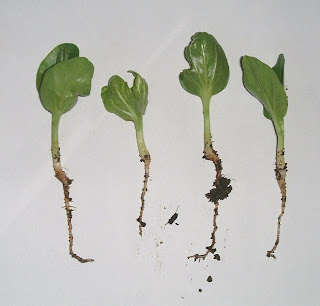
I upturned their pot, making sure I could support the compost from beneath without squashing or damaging the seedlings, and gently squeezed the sides of the pot to loosen the soil from the pot. The seedlings and their compost slid out onto the paper, and with the compost being such a gritty, loose mix there was no need for prising it apart to separate the seedlings.

four Baobab Seedlings
As you might expect, the roots were already quite deep, being about the same length down as the leaves are high. Interestingly there were no side roots at all, but they were sturdy seedlings, and not as fragile or delicate as I was expecting. In Africa these characteristics would serve them well in reducing the likelihood of damage, and in giving each seedling the best chance of being the one that survived amongst competition from other seedlings that might have germinated nearby; all fighting for water, nutrients and space.

Now each of the four seedlings has more room, with two having their own individual pots of a similar size to the one they've just been moved out of, and the other two sharing a slightly larger and notably deeper pot. I thought it wise, given how deep the roots are already, to have a go at seeing what that extra roots space will do for them. It will be interesting to watch their progression over the next few weeks to see if any problems arise, and at what rate the new leaves develop.