Showing posts with label Seedlings. Show all posts

Thursday, 2 September 2010

Seeds' day out!

After a busy two weeks the seeds and seedlings had the bank holiday weekend out and about at the Sculptree festival at Westonbirt Arboretum.


18 of the latest batch of Baobab seeds had germinated, so I separated each one out into its own pot. The Baobab and Neems seeds had come in bags of quite large quantities, even for the biggest of windowsills, so I packaged up small bags of the seeds so that visitors could have a go at growing tree seeds too!

Despite the weather there were plenty of interested visitors, and it seems like there will be plenty of seedlings too soon as all of the seeds sold! If you bought some Baobab or Neem seedlings let us know how you get on. This blog has been all about experimenting with what works, and finding out what doesn't, so I'll be really interested to read any comments or find out any tricks and tips for success.

Thursday, 6 May 2010

Neems!

Having been away for about a week I've come back to lots of fresh growth on the Baobabs and, more excitingly, two Neem germinations! This is really good stuff, as we hadn't seen any signs of life amongst so much Baobab activity, and I had been beginning to loose hope that any might germinate.

neem seedlings in tray with baobabsThe two Neem seedlings have germinated in pots marked 1 and 3, which would suggest that they are equally happy being soaked for 24 hours, or 15 minutes prior to sowing, or in fact anything in between. They've also gone from seeds to seedlings with a full set of 'true' leaves and another one on the way in what feels like quite a short space of time, certainly relative to the Baobabs anyway.

As you can see, the Neems have very different leaves to the Baobabs. Rather than having large, oval leaves with their pointed tips and smooth edges, they have three or four smaller, serrated leaves branching from a central point to make up a more feathery looking leaf. Also, whereas the cotyledon and 'true' leaves of the Baobab looked quite similar in the end, the difference between the two on the Neem could hardly be greater. The cotyledon leaves look very much like half a green peanut; small, thick, and with none of the serration or featheriness that you can see in their 'true' leaves.

I'm intrigued as to why the leaves of the two plants are so different. Tony Hill, our Programmes Director and general tree knowledge man, sayssketch of Neem seedling with labels that even young leaves that aren't cotyledons can look quite different to adult leaves, and so the Neem leaves will end up being larger and a bit more sturdy. It will be interesting to see if I can find out how these leaves are best adapted and suited to the conditions of drylands Africa.

More space for Baobab roots

The four Baobabs in the one pot that had been most successful so far have been looking a bit crowded as of late, and so it seemed about time that they got their own homes.

Using the same winning combination of paper on the kitchen floor and sharp sand/compost mix I set about taking the seedlings out of the one pot and repotting them in their own pots; a process known in the gardening trade as pricking out.

I upturned their pot, making sure I could support the compost from beneath without squashing or damaging the seedlings, and gently squeezed the sides of the pot to loosen the soil from the pot. The seedlings and their compost slid out onto the paper, and with the compost being such a gritty, loose mix there was no need for prising it apart to separate the seedlings.
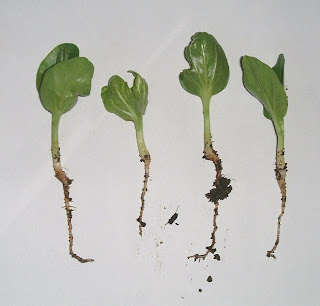
four Baobab Seedlings
As you might expect, the roots were already quite deep, being about the same length down as the leaves are high. Interestingly there were no side roots at all, but they were sturdy seedlings, and not as fragile or delicate as I was expecting. In Africa these characteristics would serve them well in reducing the likelihood of damage, and in giving each seedling the best chance of being the one that survived amongst competition from other seedlings that might have germinated nearby; all fighting for water, nutrients and space.

Now each of the four seedlings has more room, with two having their own individual pots of a similar size to the one they've just been moved out of, and the other two sharing a slightly larger and notably deeper pot. I thought it wise, given how deep the roots are already, to have a go at seeing what that extra roots space will do for them. It will be interesting to watch their progression over the next few weeks to see if any problems arise, and at what rate the new leaves develop.

Thursday, 15 April 2010

Almost a forest

I haven't been disappointed - in the last week another two Baobabs have germinated, and one pot in particular is looking rather densely canopied!


four Baobab seedlings in a potOne seedling has arrived in one of the pots marked '3' in the propagator, and I found the seed case actually lying on top of the soil next to it. When the seeds sprout it seems that they put down a root, and then push up the stalk with the cotyledon leaves and the seed case still around them, which is shed as they unfurl.


Most of the action however is still in the pot marked '2' that the first seedling germinated in. Four out of the five seeds I planted in the pot have now germinated, and the big cotyledon leaves are making it look quite crowded. In a couple of the seedlings you can just see the first pair of 'true' leaves, which is quite exciting. They are quite hard to photograph at such close range, so I've done a sketch to try and give a clearer picture of what's going on.
Sketch of seedlings I think the next task will be to separate out the seedlings in this pot. As dryland trees I would imagine their roots will go down, rather than out, to search out the deep water reserves that they would survive from in the desert plains of Africa. So whilst I'm not too worried about their roots becoming tightly tangled together at this stage, I am interested to see how deep they are relative to the height of the seedline, and to make sure they have enough room to keep going!